

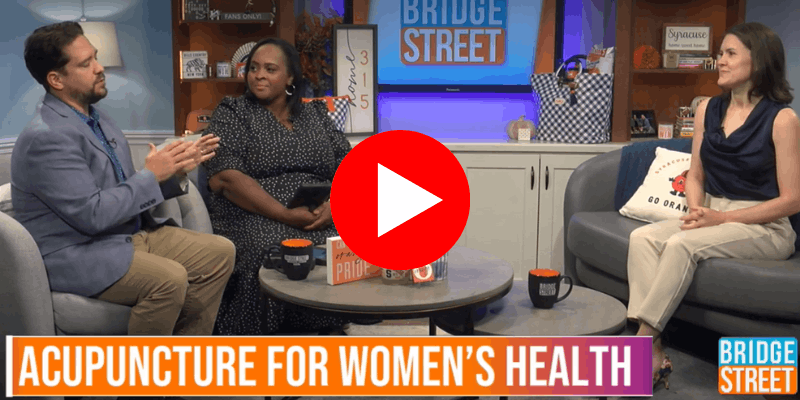
Seneca Falls Acupuncture was thrilled to be featured a fourth time on New Channel 9's popular live morning show, Bridge Street.
Clinic Director Michelle Grasek sat down with hosts Iris and Erik to discuss how acupuncture can help with a variety of women’s health symptoms and conditions.
Common women’s health symptoms that we see in our clinic include:
- – Hot flashes
- – Morning sickness
- – Painful period
- – Irregular period
- – Endometriosis
- – PMS
- – Migraines before/during the period
- – Fertility
- – And more
You can read our Acupuncture for Women’s Health page here for a detailed review of how acupuncture works for women’s health, what it may be able to help with, and more.
Erik and Iris had great questions about acupuncture for women’s health, including:
- – People often think of acupuncture for pain. Are there any women’s health concerns that people would be surprised acupuncture can help with? (Yes, many!)
- – We’ve heard acupuncture can help with morning sickness?
- – Are there any symptoms that women are taught are “normal” that they may actually not have to suffer through?
- – How does acupuncture help with hot flashes?
- – What would you say to a patient who has never had acupuncture before and is worried about needles?
- – How can people get started or who can they speak to with questions?
Watch the video here for all the answers (4 minutes).
Or read the full video transcript here:
Iris St. Meran: Acupuncture can help a number of problems, not just back or neck pain.
Erik Columbia: Our next guest, an acupuncturist, is here to share some helpful reminders and tips for women’s health. We welcome back Michelle Grasek to Bridge Street. We appreciate you stopping by once again.
Michelle Grasek: Thank you for having me.
Erik Columbia: What are some health concerns for women that people might be surprised acupuncture can help?
Michelle: There are so many. Acupuncture can be very helpful for all different symptoms and conditions in women’s health, things like painful periods, irregular cycles, migraines, PMS, fertility, morning sickness and hot flashes. The list goes on.
Iris: Are there certain women’s health symptoms that people tend to put up with because they think they’re normal?
Michelle: Yes. We see a lot of patients who just grew up thinking a really painful period was normal, including cramping or really bad migraines before or during their period. Then they learn that acupuncture can help reduce those symptoms a lot.
We always say that if people are missing a day of work or a day of school every single month because they’re so uncomfortable, they should try acupuncture. Even if it doesn’t eliminate those symptoms, it can usually really soften them so they can continue doing their normal activities.
Erik: What about women during pregnancy? Some people experience a lot of morning sickness. Can acupuncture help?
Michelle: Yes, absolutely. I think this is another thing people tend to think is normal. Some people have morning sickness during pregnancy and some people don’t, and if they have it, they think, “I’m just going to have to power through until it ends.” But acupuncture can be very, very helpful.
Iris: How many treatments are usually needed before people start to see a difference?
Michelle: If we’re treating pain, usually the recommendation is one treatment a week for six to eight weeks. For something like women’s health, we do like to see people for a little bit longer. Usually, if we can, once a week for three months is ideal.
It takes a little more time to regulate the hormones and get them to a place where they’re balanced. That doesn’t mean people won’t start to see a shift before then and start feeling better, but three months is really the sweet spot.
Erik: I feel like you can’t go online these days without somebody talking about how they might be able to help you with perimenopause or menopause. Acupuncture, I’m assuming, can help with that as well?
Michelle: Yes, absolutely. It’s a very trendy topic, right? Acupuncture tends to help with hot flashes, mood changes, poor sleep and changes in the cycle as well.
Iris: What would you say to someone who might fall into any of these categories and is thinking about acupuncture but hasn’t tried it before and might be a little nervous?
Michelle: Usually when people think of needles, they’re nervous, but they’re almost always thinking of a different kind of needle. Acupuncture needles are incredibly thin. They’re the width of a human hair. If you want to be really cute, they’re the width of a cat’s whisker.
Whatever someone is imagining the experience is going to be like, it’s usually so different. You get to lie down in a quiet room. Sometimes the table warmer is heated, although not in the summer! Overall, it’s very relaxing, and people are usually not expecting to take a nap or feel good while it’s happening.
Erik: I want to go back to the hot flashes because I’m curious how acupuncture might help someone with hot flashes. Does it actually cool your body down?
Michelle: Acupuncture can help regulate the hormones. When someone is getting a hot flash, usually that means their estrogen levels have dropped. The part of the brain that acts like your thermometer, your temperature regulation, gets a little confused.
It says, “I’m really hot,” when that’s not actually the case. It tries to cool the body down by making you sweat and causing flushing. What acupuncture is doing by helping regulate estrogen is gently helping the brain realize, “Oh, we’re not that hot. We don’t need to sweat right now.”
Iris: If somebody is watching this and thinking, “I need acupuncture for one of the conditions we just mentioned,” what’s the first thing they should do?
Michelle: They should always call us.
Iris: I didn’t know if they needed a referral from a physician.
Michelle: Great question. You don’t need a referral to see an acupuncturist. Every once in a while, we’ll get someone who comes in with an actual prescription from their doctor, which is delightful, but it’s not necessary.
You can go straight to your acupuncturist and make an appointment. You can always call in advance to ask questions as well. We get a lot of questions over the phone, and we’re happy to chat with people about what they’re experiencing and whether acupuncture is specifically helpful for that.
Erik: Every time you come in, I’m always so fascinated by how much acupuncture can actually help. I appreciate you stopping by Bridge Street again.
Michelle: Thank you so much.
Erik: You can learn more about how Seneca Falls Acupuncture can help you at SenecaFallsAcupuncture.com. This segment has been sponsored by Seneca Falls Acupuncture.
Seneca Falls Acupuncture
(607) 216-8112 | info@senecafallsacupuncture.com
Proudly serving Seneca Falls, Waterloo, Auburn, Skaneateles, Canandaigua, Geneva, and the greater Finger Lakes region since 2019.

1 Comment on Acupuncture for Women’s Health: Seneca Falls Acupuncture Featured on NewsChannel 9’s Bridge Street
Comments are closed.